


Smart-home devices are designed to disappear into everyday life. A lock opens from an app, a sensor sends an alert, and a camera watches an entryway without much attention from the homeowner. That convenience depends on something decidedly ordinary: the battery inside the device.
When comparing lithium AA batteries vs. alkaline, neither chemistry is the automatic winner for every product. Alkaline AA batteries are affordable and practical for many low-drain indoor devices. Single-use lithium AA batteries can make more sense when a device draws more power, operates outdoors, sits in a difficult-to-reach location, or needs dependable voltage over a longer service interval.
The useful question is not “Which battery is best?” It is “Which battery fits this device, this location, and the consequences of an unexpected shutdown?”
Start With the Device Manual
AA describes a battery’s physical size, not its chemistry. Two AA batteries may fit the same compartment while behaving differently under load. Some devices accept several chemistries, while others specify one type or warn against certain alternatives.
Before changing battery chemistry, check the device manual, the label inside the battery compartment, and the manufacturer’s support page. Pay attention to:
• The required battery size and nominal voltage
• Whether the device calls for alkaline, lithium, or rechargeable batteries
• Warnings against mixing battery types, brands, ages, or charge levels
• Instructions for installation, storage, and replacement
This matters especially for security equipment, alarms, smart locks, and other devices where a low-battery event can affect access or monitoring. A battery upgrade should never override the device maker’s instructions.
How Alkaline AA Batteries Fit Everyday Use
Alkaline AA batteries remain a sensible default for many common household products. They are widely available, usually inexpensive per cell, and well suited to devices with modest or intermittent power demands.
Examples may include wall clocks, basic remote controls, simple toys, and some indoor sensors. In these uses, paying more for a higher-performance chemistry may not deliver enough practical benefit to justify the added cost.
Alkaline batteries are also convenient when a battery compartment is easy to reach and replacement is no disruption. If a remote stops working, changing its batteries takes less than a minute. The cost of failure is low.
Their limitations become more noticeable when a device has frequent wireless activity, a motor, a bright light, or demanding electronics. Performance can also vary with temperature and load. That does not make alkaline batteries poor products; it means the application matters.
Where Lithium AA Batteries Can Make More Sense
Single-use lithium AA batteries are designed for situations where energy demands and operating conditions place more pressure on a battery. They are commonly considered for outdoor cameras, smart locks, high-output flashlights, handheld electronics, and other devices that may benefit from a stable power supply.
Four conditions can make lithium AA batteries worth considering:
1. The Device Has Higher or Variable Power Demand
A connected camera may wake, detect motion, capture video, illuminate a scene, and transmit data. A smart lock may briefly drive a motor. These short bursts can place more demand on a battery than a clock or remote control does.
Battery life still depends on device design, signal strength, settings, activity level, and temperature. No battery can guarantee a fixed runtime across all homes. However, chemistry becomes more important as the device’s power profile becomes more demanding.
2. The Device Is Outdoors
Outdoor equipment may face heat, cold, and rapid temperature changes. Battery performance ratings differ by product, so homeowners should compare the battery maker’s stated operating range with the device maker’s requirements.
This is one reason outdoor security cameras and trail cameras are often discussed in conversations about AA lithium batteries. The decision should be based on documented compatibility and conditions at the installation site, not on a universal claim that one battery works everywhere.
3. Replacing the Battery Is Inconvenient
A sensor near the ceiling, a camera mounted under an eave, or a lock used by several family members creates a higher replacement cost than a TV remote. That cost includes time, ladder access, schedule disruption, and the chance that the device is unavailable when it is needed.
For hard-to-reach devices, a longer replacement interval may be worth a higher upfront battery price. The most useful comparison is cost per service interval, not simply cost per cell.
4. The Consequence of Downtime Is Higher
A stopped toy and an offline entry sensor are not equally urgent. Homeowners may reasonably choose a more conservative battery strategy for access, monitoring, or emergency equipment.
That strategy should include more than chemistry. Enable low-battery alerts when available, keep a replacement set on hand, and record the installation date. Redundancy and maintenance habits often matter as much as the battery itself.
A Practical Room-by-Room Decision Guide
The following framework helps translate technical differences into household decisions.
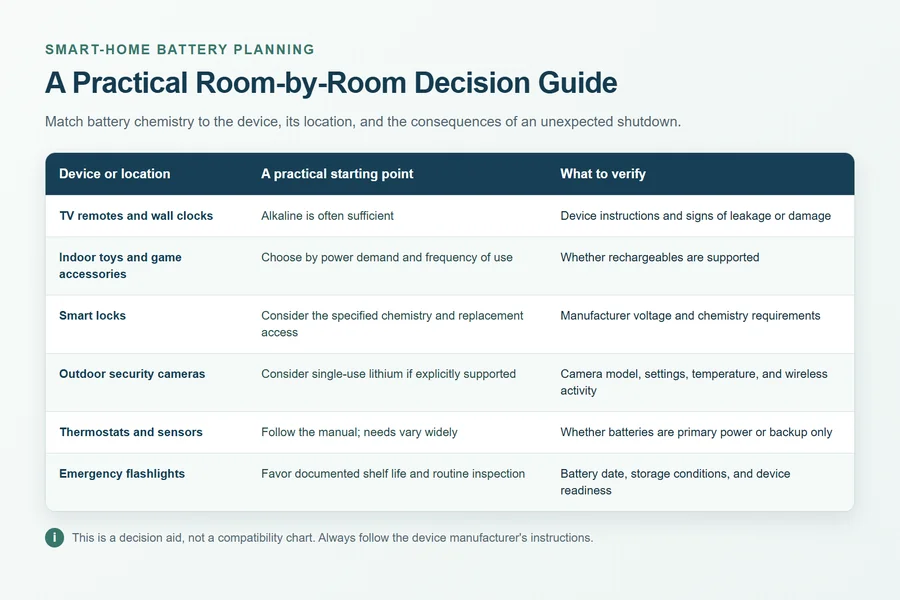
Products within the same category can have different electrical requirements. Always follow the device manufacturer’s instructions.
Compare Total Cost, Not Just Shelf Price
Alkaline batteries often win the checkout comparison because their upfront price is lower. Lithium AA batteries may create better value when they reduce replacement frequency in a demanding or inconvenient application.
A simple household comparison can include:
1. The price of the battery set
2. How often the device needs replacement under actual use
3. The time or access required to change batteries
4. The impact of unexpected downtime
5. Whether unused batteries can be stored and rotated before their marked date
Track replacement dates for important devices for six to twelve months. That record is more useful than a generic runtime promise because it reflects the home’s actual camera activity, wireless conditions, climate, settings, and usage.
Households evaluating single-use lithium options can review available pack sizes in BEVIGOR’s AA lithium batteries collection. Check the live product page and the device manual before purchasing, and select a pack size that can be used within the batteries’ marked storage period.
Use and Store AA Batteries Safely
Good battery practices apply regardless of chemistry:
• Do not mix old and new batteries in the same device.
• Do not mix chemistries unless the device manufacturer explicitly permits it.
• Match positive and negative terminals to the device markings.
• Never attempt to recharge a battery labeled non-rechargeable.
• Store spare batteries in their original packaging in a dry location away from heat and metal objects.
• Remove batteries from devices that will be stored for an extended period, if the device instructions recommend doing so.
• Keep all batteries away from young children.
End-of-life rules vary by chemistry and location. The U.S. Environmental Protection Agency advises consumers to identify batteries by their labels, check local or state requirements, and use appropriate collection or recycling options. Its used household batteries guidance specifically notes that lithium single-use batteries should not be placed in household trash or municipal recycling bins.
The Bottom Line
The lithium AA batteries vs. alkaline decision becomes easier when the device is evaluated first.
Choose alkaline when the device has modest power needs, stays indoors, is easy to access, and carries little consequence if the batteries run down. Consider single-use lithium AA batteries when the device supports them and must handle higher demand, outdoor conditions, difficult access, or a more important reliability role.
In a smart home, the best battery plan is rarely one chemistry in every drawer. It is a small system: follow device
requirements, match the battery to the job, track replacement dates, keep compatible spares, and dispose of used cells correctly.
Frequently Asked Questions
Can lithium AA batteries replace alkaline AA batteries?
Sometimes, but physical fit alone does not confirm compatibility. Check the device manual for the required chemistry and voltage before switching.
Are lithium AA batteries rechargeable?
Not necessarily. Many 1.5-volt lithium AA batteries are single-use and must never be recharged. Rechargeable lithium products use different designs and charging requirements. Read the battery label carefully.
Which AA batteries are better for outdoor smart-home devices?
Use the chemistry specified by the device manufacturer. If the device supports single-use lithium AA batteries, they may be worth considering for outdoor or hard-to-reach installations. Actual service life varies with temperature, settings, activity, signal strength, and device design.
How should used lithium AA batteries be discarded?
Follow the battery label and local rules. The EPA recommends taking lithium single-use batteries to an appropriate battery recycler or household hazardous-waste collection option rather than putting them in household trash or municipal recycling.
