

You walk into a tackle shop looking for a fly line and fly rod, and the sales assistants suggest a raft of recommendations on what fly fishing manufacturers consider the ideal fly line-fly rod combination. You act on the suggestions and purchase a fly line and rod.
But when you hit the shores and begin casting, you start to suspect you might have gotten a raw deal. So, what went wrong?
Well, several factors determine the efficiency of a fly line and fly rod.
In this article, we shall examine how to match the two equipment for a successful fishing experience.
Overview of Fly Lines and Fly Rods
Fly Line Anatomy
Most fly lines average 85 – 100 feet. However, you can find lines as long as 500 feet or even higher (if you also include the amount of backing). The ideal fly line length should take into account three critical factors – your target game fish, fishing ground, and angling experience.
Another interesting thing to note is that fly lines typically have different diameters throughout their lengths. Each line features a unique shape and taper. However, despite their thickness variations, most fly lines have a similar basic anatomy, which includes the tip, front taper, rear taper, belly, and running line.
A fly line’s tip connects the rest of the line to the leader, whereas the running line attaches to the backing.
The belly is the thickest and heaviest section of a fly line, whose primary role is loading the rod. It may be located towards the line’s front end or within its first half.
When shopping for a quality fly line, you may encounter the words “weight-forward,” “double-taper,” and “floating or sinking lines.”
- Weight-forward fly lines have thicker bellies at their front sections and are typically labeled WF. For instance, a 5-weight line would bear the label WF5.
- Weight-forward lines are remarkably easy to cast due to their greater momentum. Such lines are perfect for beginner anglers.
- Double-taper fly lines have longer and thinner tips, making them excellent for stealth fishing. They’re best suited for catching smaller or skittish fish.
- Floating and sinking fly lines derive their names from their behaviors when cast. Floating lines are recommended when fishing in shallow water, whereas sinking lines are excellent for deep-water fishing.

Fly Rod Anatomy
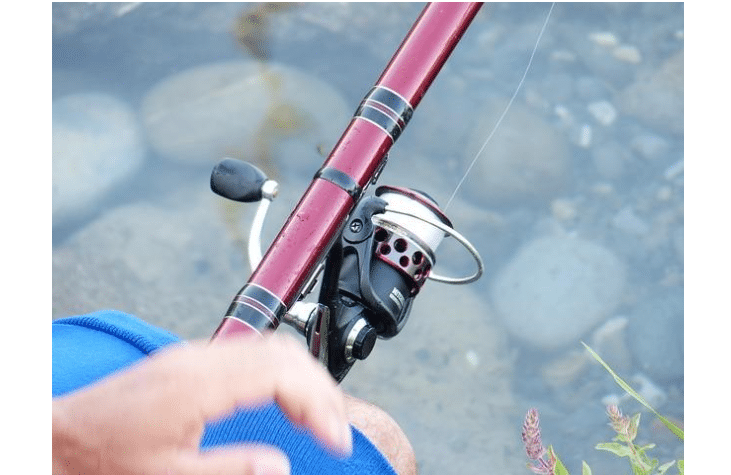
As fly lines come in different lengths, fly rods are equally available in multiple weight ratings.
Most fly rods range from 2 – 14 weight (wt).
Lower-weight rods are lighter and easier to handle. They’re better suited for smaller fish. Conversely, higher-weight fly rods are heavier and ideal for targeting larger game fish species.
However, in the final analysis, there’s no such thing as an ideal fly rod weight. Each weight rating depends on your target fish species, angling technique, and fishing grounds.
Matching a Fly Line with a Fly Rod
Manufacturers typically rely on two principles when assigning fly line ratings – computer technology and field-tester opinions. As for the rods, the focus is usually what manufacturers believe to be the average casting distance.
However, these approaches fall short when you consider that different anglers employ different casting skills. Much like the varied plots and styles found in short stories, no two anglers are the same. A fly rod’s recommended line weight may work for one person but not another, even if both are fishing in the same location. The personal technique, just like the unique twists in a short story, can significantly alter the experience and the outcome.
The good news is that every fly rod can cast different-weight fly lines, albeit with varying efficiencies.

Narrowing Down Your Choice
As mentioned, each angler has their preferred casting distance. That could range from 30 to 100 feet or more, depending on individual experience and the fishing ground.
To better understand how casting distance impacts the choice of a fly line and rod, it’s important to highlight another essential concept – the grain-weight standards assigned to each fly line.
Most North American fly line manufacturers adhere to the American Fly Fishing Tackle Association’s grain-weight standards for the first 30 feet of their fly lines. According to these standards, the first 30 feet of an 8-weight line should weigh 210 grains.
But as you shall find, every inch of a fly line cast doesn’t necessarily correspond with its theoretical weight. The implication is that manufacturer pairing recommendations for fly lines and fly rods aren’t always ideal.
Another interesting fact is that not all angling manufacturers adhere to the industry standards for fly lines and fly rods. Moreover, a manufacturer’s labeling may be grossly misleading.
In view of these inconsistencies, the surest way to match a fly line with a fly rod is to test-drive multiple pairs to find what works for you.
Start by knowing the line weight a fly rod was designed to cast. That should give you a better idea of your limits so you don’t go experimenting with widely incompatible line and rod pairs.
Note that most weight reels are available as 4/5/6 or 5/6. Such reels can safely hold 4, 5, or 6-weight fly rods.
Armed with the manufacturer’s recommendations, purchase a fly rod and then test different lines on it.
It may be intuitive to use a 5WT line on a 5WT rod simply due to the numerical consistencies in their ratings. But, upon further experimentation, you might discover that a 5WT rod works more efficiently with a 6WT line.
Experts also encourage trying different fly line designs (sinking, floating, double-taper, etc.) on a fly rod to find what works.
The Bottom Line
Pairing a fly line with a fly rod is essential when planning out a fishing trip.
Since there’s no such thing as a match made in heaven when it comes to fly lines and fly rods, it’s prudent not to rely solely on the manufacturer’s ratings. Instead, think of it like an investment strategy—try out different line weights on your rod to find what yields the best return for your personal style.
