

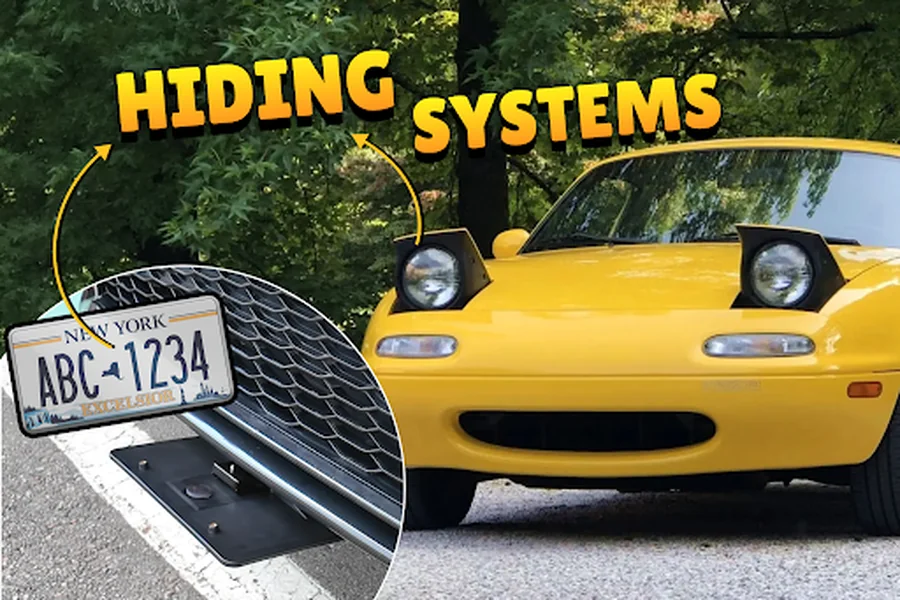
American car culture has always celebrated the ability to make a vehicle feel personal. From chrome details on classic cruisers to the sculpted bodies of muscle cars, enthusiasts have used design to express identity. Moving components added another dimension: they allowed a car to transform rather than simply display a fixed appearance.
That fascination extends to accessories. A motorized license plate flipper offered by Alite illustrates how a compact powered mechanism can change the position of an exterior component. Such devices are restricted or prohibited in several states, and license plates must remain legally displayed and readable on public roads.
The American Tradition of Personalization
In the United States, customizing cars developed alongside hot rods, drag racing, and local cruising scenes. Owners changed grilles, suspension heights, paint finishes, and interior details to give familiar vehicles a distinctive character.
Some modifications focused on performance; others emphasized presentation. Car shows became places where craftsmanship could be appreciated, from carefully finished engine bays to inventive bodywork.
The desire for individuality encouraged builders to experiment with parts that opened, folded, lifted, or disappeared into surrounding panels.
Pop-Up Headlights and Dramatic Design
Retractable headlights became an unmistakable styling feature on several American sports cars. The Chevrolet Corvette helped make the look familiar, while other models explored their own approaches to concealed lighting.
When the lamps were closed, the hood and front fascia appeared smoother. Switching them on changed the car’s expression. That movement became part of the driving experience, not merely a technical necessity.
The design also came with compromises. Motors, pivots, wiring, and alignment points required attention. As lighting technology and safety requirements evolved, fixed headlamp assemblies became more practical for many manufacturers.
Still, pop-up headlights remain a memorable example of engineering used to create visual theater.
From Mechanical Tricks to Powered Features
American customization expanded beyond lighting. Lowrider culture embraced adjustable suspension as a form of creative expression, while show cars experimented with powered doors, trunks, and other moving panels.
Modern production vehicles have made electronically controlled motion more familiar through features such as powered tailgates, retractable running boards, and active aerodynamic elements.
These systems differ in purpose, but they share a design principle: movement should deliver a recognizable benefit or experience.
Common examples include:
- Retractable headlights: Change the front-end appearance when lighting is activated.
- Powered running boards: Extend to assist entry and retract afterward.
- Active spoilers: Adjust their position under specified driving conditions.
- Motorized convertible roofs: Transform the cabin between enclosed and open configurations.
- Powered cargo doors: Improve access when carrying luggage or equipment.
Each feature requires space for movement, reliable controls, and protection against everyday wear.
Why Compact Motors Changed the Possibilities
Smaller electric motors and controllers allow designers to package movement inside increasingly tight spaces. Instead of relying on large mechanical linkages, some accessories use compact actuators connected to switches or vehicle electronics.
That does not make installation effortless. A mechanism still needs secure mounting, appropriate electrical protection, and clearance throughout its travel.
American drivers also encounter widely varying conditions. Desert heat, northern winters, road salt, and heavy rain can challenge exposed moving parts. Corrosion resistance and dependable sealing matter as much as appearance.
Good customization should work reliably after repeated use, not only during a demonstration at a car meet.
Car Shows, Street Use, and the Law
A display vehicle at a private exhibition operates in a different context from a daily driver on public streets. An accessory that attracts attention at a show may not be lawful to install or operate on the road.
License plate mechanisms are a particularly important example. Several states prohibit devices that flip, conceal, or change the displayed registration plate. Pennsylvania law expressly prohibits possessing, installing, selling, and using defined registration plate flipping devices.
Other states regulate plate obstruction through broader visibility requirements. Drivers should consult current state law before considering any exterior modification affecting vehicle identification.
Legal compliance is not an optional styling preference. Clear plates help support registration checks, traffic enforcement, and vehicle identification.
What Today’s Builders Can Learn
The history of moving automotive features offers useful lessons for contemporary American enthusiasts. Dramatic motion attracts attention, but it can also introduce maintenance needs and unexpected failure points.
Before choosing a powered accessory, builders should ask whether it fits the vehicle’s design, whether replacement parts are available, and whether the feature can be operated safely.
The Next Chapter of American Customization
American automotive styling continues to combine nostalgia with new technology. Classic pop-up headlights remain icons, while today’s compact electronics enable different kinds of movement and control.
The enduring attraction is not simply that something moves. It is the moment when engineering, personality, and purpose come together in a memorable design. As customization evolves, the strongest ideas will respect that heritage while prioritizing durability, safe operation, and the rules that govern vehicles on American roads.
