

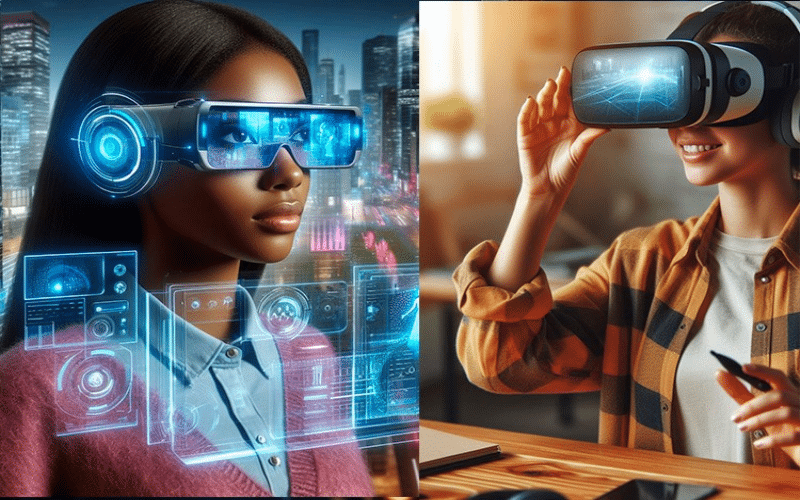
Virtual reality (VR) technology has seen significant advancements over the past few decades, transforming from a science fiction concept into a practical tool with numerous applications. VR creates immersive, computer-generated environments that can simulate the real world or fantastical scenarios, providing users with a unique interactive experience. This article explores the development of VR technologies and their diverse applications across various fields.
Development of VR Technologies
Historical Background – The concept of VR can be traced back to the 1960s with the invention of the Sensorama by Morton Heilig, which provided an immersive experience using stereoscopic images, sound, and even smells.
In 1968, Ivan Sutherland and his student Bob Sproull developed the first head-mounted display system, often considered the first true VR device.
The 1990s saw a surge in VR interest with the release of devices like the Sega VR and Nintendo Virtual Boy, though these early consumer products were limited by technology and did not achieve widespread success.
Technological Advancements – Hardware: Modern VR relies on sophisticated hardware, including high-resolution displays, motion sensors, and powerful computing capabilities. Companies like Oculus (now part of Meta), HTC, and Sony have developed advanced headsets such as the Oculus Rift, HTC Vive, and PlayStation VR.
Software: VR software has evolved to provide more realistic and interactive experiences. Game engines like Unity and Unreal Engine are widely used to develop VR content, offering tools for creating detailed virtual environments and complex interactions.
Input Devices: Motion controllers, haptic feedback devices, and even full-body tracking systems have been developed to enhance the user’s sense of presence and interaction within VR environments.
Challenges and Solutions – Latency: Reducing the delay between user actions and system responses is crucial for maintaining immersion. Advances in processing power and optimization techniques have helped mitigate latency issues.
Field of View (FOV): Expanding the FOV to match natural human vision enhances the realism of VR. Modern headsets aim for wide FOVs and high refresh rates to prevent motion sickness.
Accessibility: Making VR affordable and comfortable for extended use remains a challenge. Lightweight designs and competitive pricing are key focus areas for manufacturers.
Applications of VR
Gaming and Entertainment – VR has revolutionized the gaming industry by providing players with fully immersive experiences. Games like “Beat Saber” and “Half-Life: Alyx” showcase the potential of VR for interactive storytelling and gameplay.
The entertainment industry also uses VR for virtual concerts, theme park rides, and interactive movie experiences, allowing audiences to engage with content in new ways.
VR also is making significant inroads into the online gambling industry, transforming how players experience casino games. online casinos in Singapore aim to replicate the experience of being in a real casino, complete with realistic environments, sounds, and interactions. Players can walk around virtual casino floors, sit at gaming tables, and interact with dealers and other players. Popular games such as poker, blackjack, and roulette have VR versions that enhance the social and immersive aspects of gambling. VR can also introduce new game formats that are not possible in traditional casinos, offering innovative gameplay experiences.
Education and Training – VR offers immersive learning environments, enabling students to explore historical events, conduct virtual science experiments, and practice skills in a safe, controlled setting.
Professional training programs in fields like medicine, aviation, and the military use VR to simulate real-life scenarios, providing hands-on experience without the associated risks.
Healthcare – VR is used in therapy and rehabilitation, helping patients with conditions such as PTSD, anxiety, and chronic pain. VR simulations can provide controlled environments for exposure therapy and physical rehabilitation exercises.
Surgeons and medical students use VR for training and preoperative planning, allowing for practice on virtual patients and exploration of complex procedures.
Architecture and Real Estate – Architects and real estate developers use VR to create virtual walkthroughs of buildings and spaces, offering clients a realistic sense of scale and design before construction begins.
VR allows for interactive modifications, enabling clients to see changes in real-time and make informed decisions about layouts and designs.
Social and Collaborative Spaces – VR platforms like VRChat and AltspaceVR create virtual social environments where users can interact with others from around the world, attend virtual events, and collaborate on projects.
Businesses use VR for remote meetings and collaborative workspaces, providing a sense of presence and interaction that is difficult to achieve through traditional video conferencing.
Tourism and Travel – VR enables virtual tourism, allowing users to explore famous landmarks, natural wonders, and cultural sites from the comfort of their homes. This is particularly beneficial for individuals who may not have the means or ability to travel physically.
Travel agencies and hospitality businesses use VR to provide virtual tours of destinations and accommodations, giving potential customers a preview experience before making bookings.
Retail and E-Commerce – VR is transforming the retail sector by offering virtual shopping experiences where customers can browse and interact with products in a virtual store. This immersive shopping experience can enhance customer engagement and satisfaction.
Brands use VR to create virtual fitting rooms where customers can try on clothes and accessories virtually, reducing the uncertainty associated with online shopping and decreasing return rates.
Scientific Research – VR is used in various fields of scientific research, including environmental science, astronomy, and biology. Researchers can simulate complex systems and environments to study phenomena that are difficult or impossible to observe in the real world.
VR also aids in data visualization, allowing scientists to explore and manipulate large datasets in an intuitive and interactive manner.
Conclusion
The development of VR technologies has opened up a myriad of possibilities across various industries, enhancing experiences and providing new opportunities for interaction, education, and entertainment. As technology continues to advance, the potential applications of VR are likely to expand even further, offering exciting prospects for the future. From revolutionizing gaming and entertainment to transforming education, healthcare, and beyond, VR is poised to play a significant role in shaping how we interact with digital and physical worlds.
