

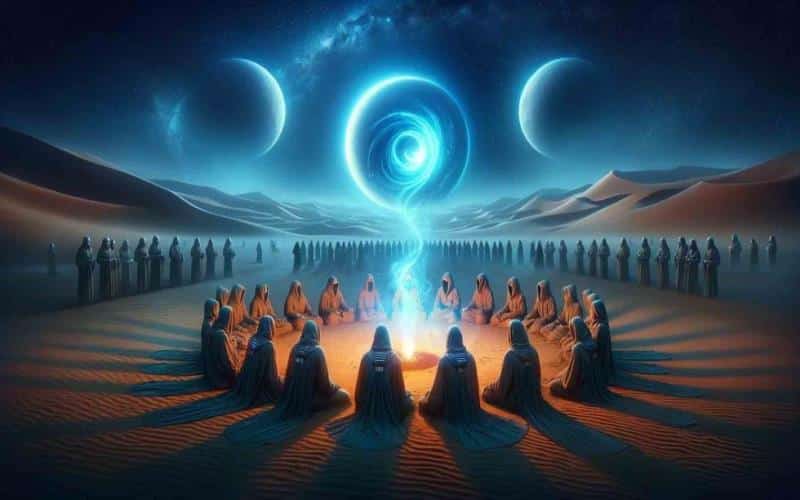
Frank Herbert’s Dune series is a cornerstone of science fiction literature, known for its intricate world-building, complex characters, and profound philosophical themes. Spanning six novels, the series explores the rise and fall of empires, the intricacies of religion and politics, and the ecological challenges of the desert planet Arrakis. The impact of these books extends beyond literature, influencing movies, television, and popular culture for decades.
The Genesis of Dune
The saga begins with Dune, published in 1965, which introduces readers to the desert planet Arrakis, the only source of the universe’s most valuable substance, melange or “the spice.” This powerful drug extends life, enhances mental abilities, and is crucial for space travel. The story centers on Paul Atreides, whose noble family takes control of Arrakis and finds themselves entangled in a web of political intrigue, betrayal, and warfare.
Herbert’s world is richly detailed, with its own ecology, religion, and social structures. The Fremen, the indigenous people of Arrakis, are key to Paul’s rise as they reveal their deep connection to the desert and its secrets. Paul’s journey from a young duke to the prophesied leader Muad’Dib, who can foresee the future, forms the crux of the first novel.
Expansion of the Universe
The success of Dune led Herbert to expand the universe with Dune Messiah (1969) and Children of Dune (1976). These sequels delve deeper into the consequences of Paul’s ascent to power. In Dune Messiah, Paul grapples with the burdens of his empire and the unintended consequences of his rule, including a jihad that spreads across the universe in his name. Children of Dune shifts focus to Paul’s children, Leto II and Ghanima, as they navigate the dangerous political landscape and their own prescient abilities.
Themes and Philosophies
Herbert’s series is renowned for its exploration of complex themes. Environmentalism is a core element, with Arrakis’s harsh desert landscape serving as both a setting and a character in its own right. The Fremen’s relationship with their environment and their dream of transforming Arrakis into a verdant paradise reflect Herbert’s deep ecological concerns.
Religion and politics are intricately woven throughout the series. The Bene Gesserit, a secretive sisterhood with extraordinary mental and physical abilities, manipulate religious beliefs to achieve their goals. The series questions the nature of power and the morality of using religion as a tool for political ends.
Continuing the Saga
Herbert continued the story with God Emperor of Dune (1981), Heretics of Dune (1984), and Chapterhouse: Dune (1985). In God Emperor of Dune, Leto II, now a tyrant who has transformed into a human-sandworm hybrid, rules the universe with an iron fist. His long reign is aimed at ensuring humanity’s survival by forcing it onto a harsh, but ultimately beneficial, evolutionary path.
Heretics of Dune and Chapterhouse: Dune take place thousands of years after Leto II’s death, exploring the fragmented universe he left behind. These novels introduce new factions and continue to explore themes of power, religion, and human potential.
The Dune Movies
The enduring popularity of Herbert’s books has led to several adaptations, the most notable being the 1984 film directed by David Lynch and the more recent adaptation by Denis Villeneuve, released in 2021. Lynch’s version, while ambitious, was met with mixed reviews due to its complexity and deviation from the source material. However, it has since gained a cult following for its unique interpretation of Herbert’s world.
Villeneuve’s adaptation, on the other hand, has been praised for its faithfulness to the novel and its stunning visual representation of Arrakis. Featuring an ensemble cast including Timothée Chalamet as Paul Atreides and Zendaya as Chani, the film captures the grandeur and depth of Herbert’s creation. The success of this adaptation has reignited interest in the series and introduced a new generation to the world of Dune.
Legacy and Influence
The Dune series has left an indelible mark on science fiction and popular culture. Herbert’s meticulous world-building and exploration of timeless themes have inspired countless writers, filmmakers, and creators. The series’ influence can be seen in other epic science fiction franchises, such as Star Wars and The Expanse.
Herbert’s son, Brian Herbert, along with author Kevin J. Anderson, has continued to expand the Dune universe with prequels, sequels, and companion novels. While these additions have been met with varying degrees of enthusiasm, they attest to the enduring fascination with Herbert’s world.
The Dune series is more than just a collection of science fiction novels; it is a profound exploration of human nature, society, and the environment. Frank Herbert’s creation has stood the test of time, continuing to captivate readers and viewers with its rich tapestry of characters, settings, and ideas. As new adaptations bring the saga to a wider audience, the legacy of Dune will undoubtedly continue to grow, inviting fans old and new to journey into the heart of Arrakis and beyond.
