

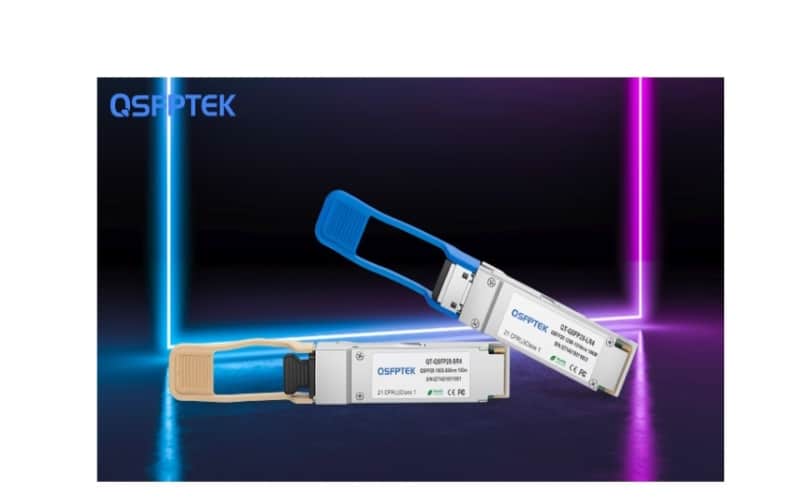
Artificial Intelligence (AI) and Machine Learning (ML) have revolutionized numerous industries by enabling complex data analysis, pattern recognition, and decision-making processes. However, the computational demands of training and deploying AI models are immense, often requiring substantial data processing and real-time responsiveness. This is where the power of 100G transceivers comes into play. By providing high-speed, low-latency connectivity, 100G transceivers can significantly enhance the performance and efficiency of AI and ML workloads, accelerating both training and inference processes.
The Computational Demands of AI and ML
AI and ML workloads typically involve processing large datasets and performing complex mathematical computations. Training deep learning models, for instance, requires multiple iterations over vast amounts of data to adjust the model parameters. This process is computationally intensive and demands robust hardware and network infrastructure to support the high throughput and low latency necessary for efficient training.
Similarly, inference—the process of using trained models to make predictions on new data—requires real-time or near-real-time processing capabilities, especially in applications such as autonomous vehicles, financial trading, and healthcare diagnostics. Therefore, both training and inference benefit significantly from high-performance networking solutions.
How 100G Transceivers Enhance AI and ML Workloads
Accelerated Data Transfers
One of the primary advantages of 100G transceivers is their ability to transfer data at very high speeds. AI and ML workloads often involve transferring large datasets between storage systems and compute nodes. With 100G transceivers, data can be moved much faster compared to traditional 10G or even 40G networks. This acceleration reduces the time required to load training data into the computing environment and speeds up the overall training process.
Reduced Latency
Low latency is crucial for both training and inference in AI and ML. During training, especially in distributed machine learning, synchronization between different compute nodes must occur frequently. High latency can lead to inefficiencies and delays, slowing down the training process. 100G transceivers offer significantly lower latency, enabling faster synchronization and communication between nodes. This leads to more efficient parallel processing and shorter training times.
For inference, low latency is essential to ensure real-time or near-real-time responses. Applications such as autonomous driving, real-time video analysis, and interactive AI systems rely on rapid inference to function correctly. The reduced latency provided by 100G transceivers ensures that these systems can deliver timely and accurate predictions.
Enhanced Scalability
AI and ML workloads often require scaling up to handle increasing amounts of data and more complex models. 100G transceivers provide the necessary bandwidth to support large-scale distributed computing environments. This scalability is particularly beneficial in data center environments where multiple GPUs and TPUs are used in parallel to accelerate AI and ML tasks. With 100G transceivers, adding more compute resources can be done seamlessly without running into network bandwidth limitations.
Improved Resource Utilization
Efficient utilization of computing resources is critical for maximizing the performance of AI and ML workloads. 100G transceivers help in optimizing resource utilization by ensuring that compute nodes spend less time waiting for data transfers and more time performing actual computations. This balance leads to higher throughput and better overall system performance, making it possible to handle more extensive and more complex AI models.
Better Support for Advanced Architectures
Modern AI and ML architectures, such as those involving edge computing and federated learning, benefit greatly from high-speed networks. In edge computing, data is processed closer to the data source, requiring high-speed connectivity to central data centers for model updates and data aggregation. Federated learning, which involves training models across decentralized devices, also requires efficient data exchanges between devices and central servers. 100G transceivers provide the high-speed, low-latency connections needed for these advanced architectures to function effectively.

Conclusion
The integration of 100G transceivers into AI and ML infrastructures represents a significant advancement in addressing the computational challenges associated with these technologies. By accelerating data transfers, reducing latency, enhancing scalability, improving resource utilization, and supporting advanced architectures, 100G transceivers play a crucial role in boosting the performance and efficiency of AI and ML workloads. As AI and ML continue to evolve and drive innovation across various sectors, the adoption of 100G transceivers will be essential in keeping pace with the growing demands of these transformative technologies.
