

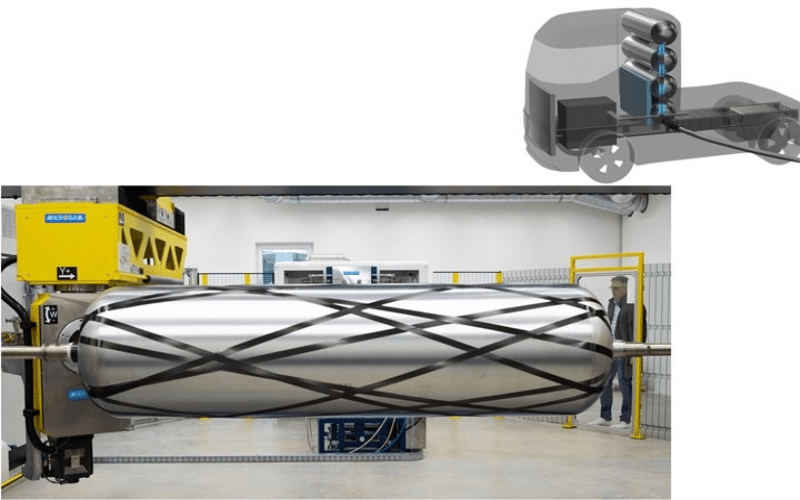
Hydrogen emerges as a promising solution, as the world aims to decarbonize various economic sectors to achieve more sustainability in energy. In 2024, the hydrogen market has significantly boomed, driven by the demand for cleaner energy technologies and the immediate need to mitigate climate change. Pivotal to the adoption of hydrogen as an alternative energy source is the development of efficient, safe, and reliable storage tanks.
Hydrogen is an abundant element that can power our lives to a great extent, given its incredibly high energy per mass. However, it leads to low energy per unit volume due to low ambient temperature density. This called for storage tank development with the potential for higher energy density to make hydrogen more practical and dispensable. This article delves into hydrogen storage tanks, exploring the markets, the materials used in their development, and design techniques.
Hydrogen Markets in 2024
The hydrogen market in 2024 has witnessed robust growth, with government agencies, industries, and consumers recognizing the danger of carbon footprint and the imperative need to reduce emissions. The International Energy Agency (IEA), a body that monitors the production and demand of hydrogen, revealed that the global demand for hydrogen will exponentially grow.
Hydrogen demand witnessed an increment of 3 million tonnes from 2019 to 2021, amounting to 94 million tonnes. The IEA discloses that this figure is partly due to the emerging hydrogen applications that are currently a work in progress. By 2030, the demand is expected to hit 130 million tonnes, based on current projections.
Countries in Europe, Asia, and North America, are fuelling market expansions with their hydrogen investments. The European Union once stated that it aims to generate about 10 million tons of renewable hydrogen by 2030, signaling a significant shift towards a total hydrogen-based economy. Japan and South Korea are taking similar strides to achieve their climate goals, partnering with several private enterprises and governments to scale up production, storage, and transportation technologies. With all these factors, the hydrogen market is poised for significant growth in the coming years.
Materials for Hydrogen Tanks
Developing effective storage tanks for safe distribution hinges on durable, strong, and cost-effective materials. Hydrogen storage tank materials vary according to their type.
- Type 1 materials are mostly steel or aluminum. These materials are more advanced and have a higher degree of pressure resistance than type 2, type 3, type 4, and type 5.
- Type 2 materials consist of carbon fiber composites, known for surviving in high-pressure conditions due to their incredible strength-to-weight ratio and high resistance to hydrogen embrittlement.
- Type 3 includes materials like metal alloys. These have become prevalent in the industry, offering increased durability and compatibility with high-pressure hydrogen environments.
- Type 4 and 5 are mainly thermoplastic polymer liners, such as polyethylene, and composite cylinders without liners. Polyethylene is gaining traction for its lightweight and rust-free abilities in low-pressure hydrogen storage.
Metal Vs. Plastic Hydrogen Storage Tanks
The ongoing debate between metal and plastic hydrogen storage tanks has caused commotion among many. With safety, performance, and cost-effectiveness in consideration, metal tanks have the edge over plastic hydrogen storage tanks.
Metal tanks, made from aluminum or steel alloys, are stronger and more durable, making them ideal for high-pressure hydrogen storage. Their high thermal conductivity results in a more complete fill. This means metal tanks can accommodate more gas and dissipate heat during filling. As a result, there’s no error in the cylinder’s capacity. Moreover, the gas mass slightly increases the vehicle’s gross weight, which improves driving range.
Still, on the upside, metal tanks can be completely emptied because the aluminum liner doesn’t collapse. As a result, a significantly higher gas volume is transported. The downside of metal tanks is that they are affected by corrosion and weight constraints.
While plastic tanks are lightweight, rust-resistant, and have lower manufacturing costs, their liners buckle. It affects the total gas volume being transported and used. For instance, if metal tanks empty 95% of hydrogen, plastic tanks only deliver 75% at most. In addition, they degrade in high-pressure conditions over time and have gas permeation concerns, which compromises safety and performance.
Ultimately, metal tanks are much better in long-term performance. They have a higher thermal conductivity and significantly take up more gas during fill operations.
CNC Machining Technique Boost Hydrogen Storage Industry
The design and manufacturing techniques for hydrogen storage tanks are becoming more innovative and advanced. Before we dive into one of these innovative manufacturing techniques, let’s explain the design process of high-pressure hydrogen storage tanks.
The design process begins with identifying the desired storage tank, the capacity, pressure, material characteristics, and safety factors. Hydrogen storage tanks come in four varieties – compressed, H2MAX compressed cryogenic, type 3, and type 4 hydrogen storage tanks.
Compressed hydrogen tanks contain compressed hydrogen gas. They’re mostly made with Type 1 and 2 materials that store gas hydrogen gas at 3,000 and 4,340 PSI. H2MAX comprises a high-pressure inner vessel built with an aluminum liner and carbon fiber to maximize storage density.
Type 3 storage tanks are designed to be more efficient in storage capacity. They are smaller and lighter and can transport large volumes of hydrogen gas over a long distance.
Type 4 storage tanks are nearly similar to Type 3, except the cylinders have a non-metallic lining. Plus, they have a lower thermal conductivity, which significantly reduces the amount of gas they can accommodate. Type 3 and Type 4 can store the same amount of hydrogen under the pressure of 10,000 PSI.
Regarding innovative manufacturing techniques, computer numerical control (CNC) machining services have emerged as an essential technology that drives the production of precision and efficient hydrogen storage tanks. This technique is a computer-controlled manufacturing process that allows the fabrication of structural components and intricate linings with tight tolerance. These days, precision CNC machining procedures create complex geometries and lightweight structures for hydrogen storage tanks.
The emergence of custom CNC machining in the hydrogen storage industry has ensured critical components of hydrogen storage tanks are manufactured with precision and adhere to safety standards and performance requirements. It improves the reliability and integrity of these storage systems, eliminating human error and the risk of leakages. In addition, CNC machining allows for the customization of tanks for specific project requirements.
One of the advantages of CNC machining is scalability. It enables the manufacture of storage tanks to meet diverse demands, offering a great deal of flexibility and efficiency in production. Besides, automation in CNC machining also improves productivity and significantly reduces labor costs.
Another benefit of CNC machining is the availability of different innovative materials. From carbon fiber composites to metal alloys, this manufacturing technique allows the accurate fabrication of tank materials for hydrogen storage applications. By adjusting material compositions and creating prototypes or design iterations, manufacturers can achieve the perfect design based on strength, weight, and durability. This will maximize the performance and longevity of the storage tanks.
As the hydrogen storage industry evolves, CNC machining companies will play a pivotal role in fuelling innovative, efficient, and sustainable designs. Hydrogen storage tanks will also have more capabilities and allow for greater adoption across various economic sectors with the rapid advancements in CNC machining and the synergy with robotics and AI.
Conclusion
Hydrogen demand will continue to soar as clean energy solutions rise. However, the challenges hindering the storage and dispensability of hydrogen gas still exist. Industry leaders and other key players must seek innovative ways to build storage tanks that allow for efficient storage, transportation, and usage of hydrogen as an alternative fuel source.
CNC machining is at the forefront of technological innovation. Manufacturers can leverage this design technique to build precise, scalable, reliable, safe, efficient, and cost-effective hydrogen storage tanks. This will lead to a greater adoption of hydrogen as a sustainable energy source and mitigate the effects of climate change.
